


Hi there, fellow investor. In this article, we review Saxo to help you decide if it is the right investment platform for you.
Saxo is a multi-asset broker that gives retail and institutional clients access to stocks, ETFs, bonds, funds and derivatives. It lists more than 71,000 instruments, including over 23,000 stocks on 50 exchanges.
The company is headquartered in Copenhagen, Denmark, and has been fully owned by the Swiss private banking group J. Safra Sarasin since 2026. It holds licences in several major jurisdictions, including Denmark, the UK, Switzerland, Singapore and Japan.
Many online brokers say they are multi-asset but, in practice, only offer CFDs (contracts for difference) on different asset classes. Saxo is one of the few brokers that gives private investors direct access to real stocks, bonds and funds as well as leveraged products like options, futures and CFDs.
Saxo also has its own trading platforms and a strong customer support team. Its fees used to be well above the market, but a price overhaul in 2024 and 2025 cut stock commissions to 0.08% on the entry account and removed custody fees in most of its European markets.
That is Saxo in a nutshell. Keep reading to see what our research team found after analysing it.
Overview
Saxo was founded in 1992 in Copenhagen by Lars Seier Christensen and Kim Fournais, and it is still headquartered there. Over three decades it grew into a global group with offices and licences in several financial hubs.
Ownership changed in 2025 and 2026. J. Safra Sarasin completed the purchase of a majority stake of about 71% in March 2026, buying out Geely and Mandatum. In July 2026, the group exercised its option to buy Kim Fournais’ remaining stake, and Saxo is now wholly owned by Bank J. Safra Sarasin. Daniel Belfer became CEO on 2 March 2026, while Kim Fournais moved to Chairman of the Board.
On the investment side, clients can buy stocks, ETFs, bonds and mutual funds. UK investors can hold these in an ISA (Individual Savings Account) or a SIPP (Self-Invested Personal Pension).
Saxo also offers a broad range of trading products, namely options, futures, forex and CFDs.
Another feature that is less common among its peers is the business account. This means companies can open an investing account with the broker and get access to the same products.
Investors trade through Saxo’s own platforms, SaxoInvestor and SaxoTrader. Demo accounts are available, so you can try the platforms before opening an account.

We look at these platforms in more detail later in this review. In simple terms, which one you use depends on whether you want to invest, trade, or both.
Saxo is regulated in several tier-1 jurisdictions, including Denmark, the UK, Switzerland, Singapore and Japan. Saxo Bank A/S has also been designated a SIFI (systemically important financial institution) in Denmark since 2023.
Saxo is a private company, but it still publishes its accounts. In the first half of 2026 it reported a net profit of EUR 87 million, EUR 153 billion in client assets and 1.7 million clients. That transparency lets investors check the strength of its balance sheet.
Highlights
| 🗺️ Supported regions | Europe, Asia and the Middle East (US persons not accepted) |
| 💰 Stocks and ETFs fees | From 0.08% per trade on the Classic account (US stocks from $1 outside the UK) |
| 💰 Custody fee | 0% in most EU markets, 0.12% in the UK (Classic) |
| 💰 Currency conversion fee | 0.25% (Saxo Bank A/S), 0.60% in the UK (Classic) |
| 💰 Inactivity fee | €/$/£0 |
| 💰 Withdrawal fee | €/$/£0 |
| 💵 Minimum deposit | €/$/£0 ($5,000 in the UAE) |
| 📈 Instruments available | 71,000+ across stocks, ETFs, bonds, funds, options, futures, forex and CFDs |
| 🎮 Demo account | Yes |
| 🏦 Ownership | 100% J. Safra Sarasin (2026), S&P rating A- (positive outlook) |
| 📜 Regulators | Danish FSA, FCA (UK), MAS (Singapore), FINMA (Switzerland), Consob (Italy), JFSA (Japan) |
Source: Saxo rates and conditions and Saxo investor relations, checked in September 2026.
Pros and cons
Pros
- Excellent research materials
- Outstanding trading platforms (SaxoInvestor and SaxoTrader)
- Extensive range of investment products and commercial offers
- Long track record
- Supervised by worldwide top-tier regulators
Cons
- $0 in most countries; higher minimums in some regions (e.g. $5,000 in MENA)
- Fees higher than average
- Fee structure is complex
- Does not accept US residents
Trading platform
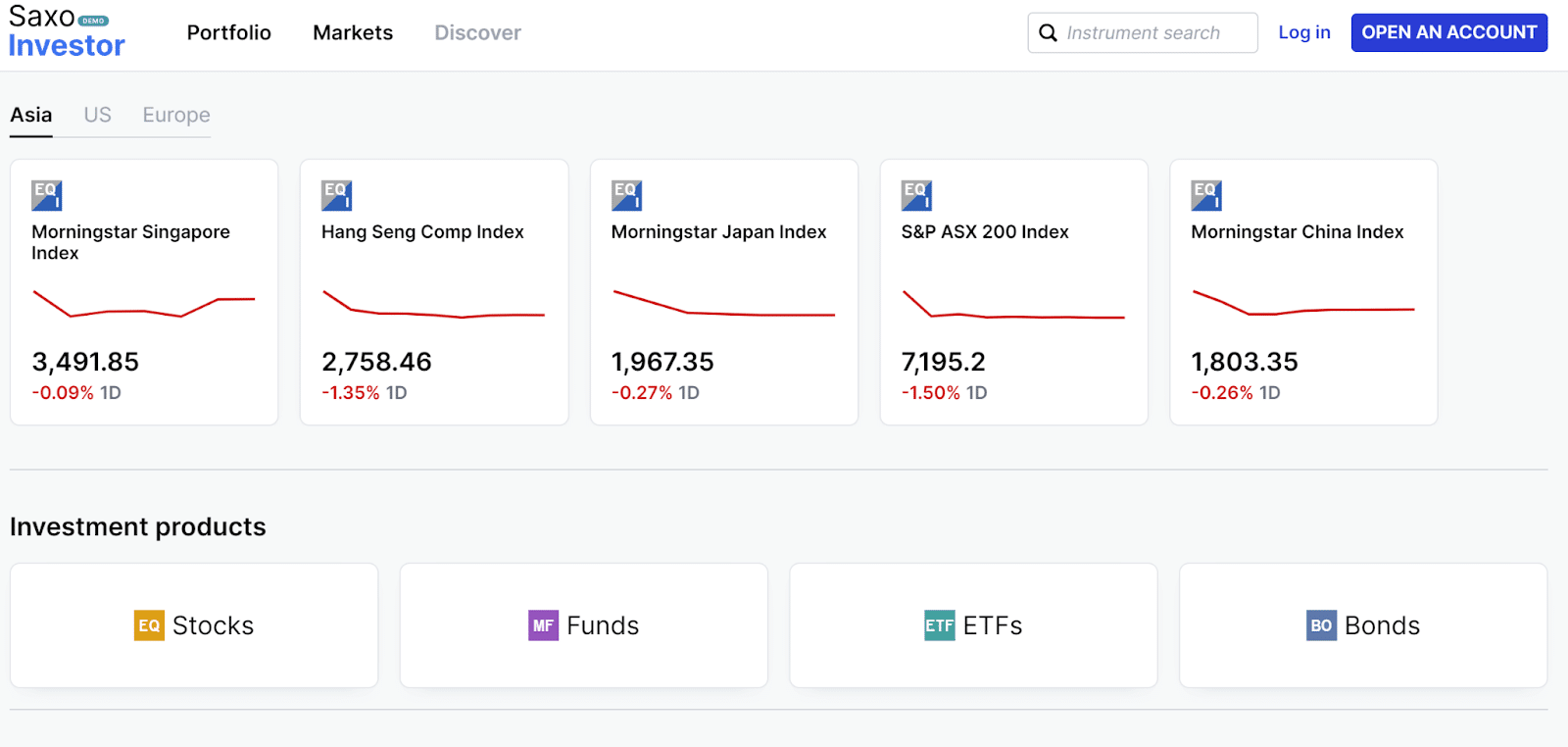
Saxo offers two proprietary platforms: SaxoInvestor and SaxoTrader. With a single Saxo account you get access to both and can switch between them at any time.
SaxoInvestor is the simpler platform, designed for long-term investors. It gives you access to stocks, ETFs, mutual funds and bonds, with a clean interface focused on building a portfolio rather than active trading. It is available on web and mobile, and it suits passive investors who want straightforward execution.
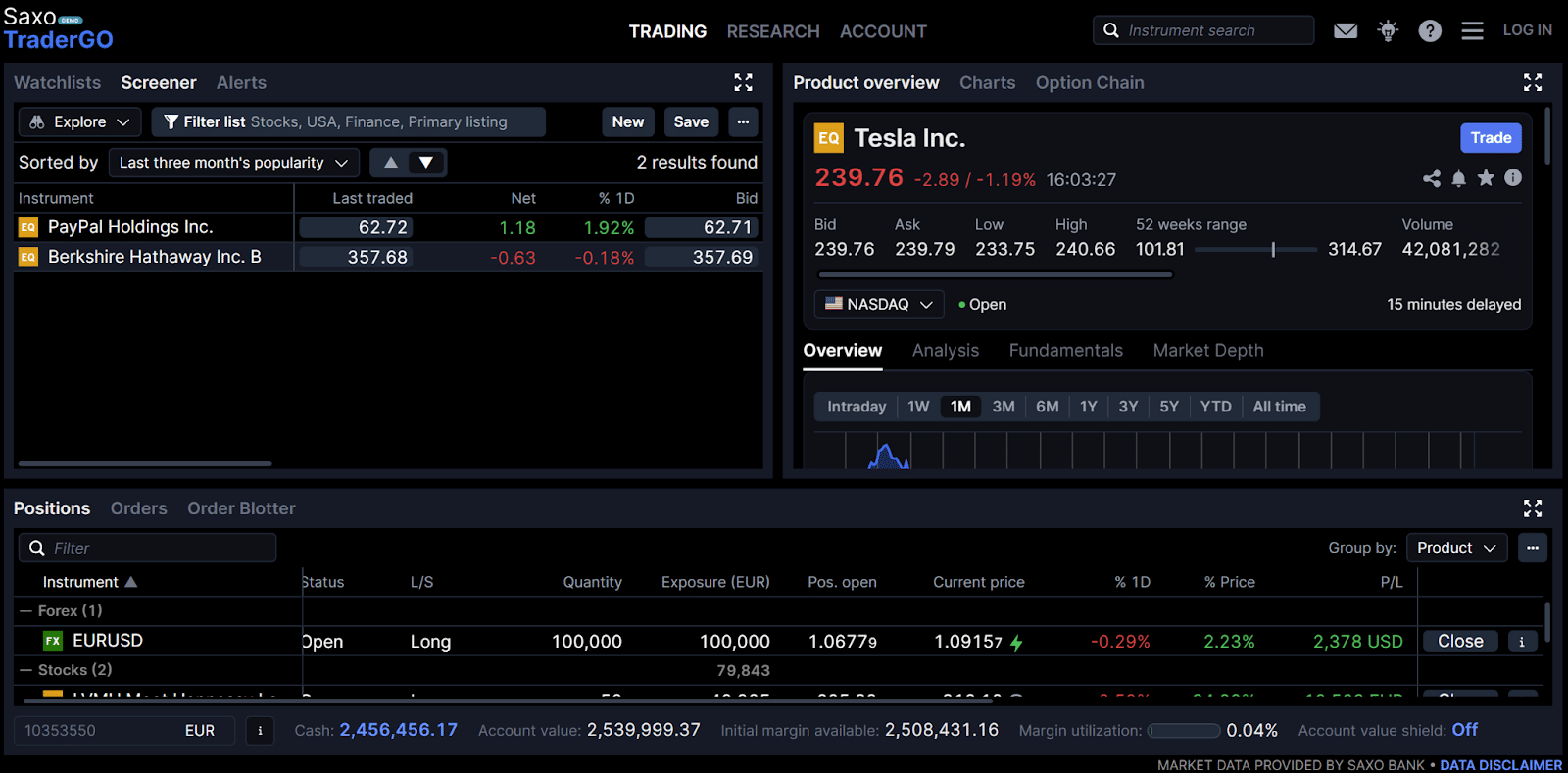
SaxoTrader is the advanced platform, available on web, mobile and desktop (formerly SaxoTraderGO and SaxoTraderPRO). It gives you access to the full product range, including stocks, bonds, ETFs, options, futures, CFDs and forex, with detailed analytics, advanced charting and risk management tools. The desktop version supports multi-screen layouts and suits active and professional traders.
Saxo can also be used through third-party tools. TradingView lets you trade stocks, futures, forex and CFDs on your Saxo account directly from its charts. Professional traders and institutions can connect through Saxo’s OpenAPI or FIX. Saxo does not offer MetaTrader.
Products and markets
Saxo has one of the largest product ranges among retail brokers.
Depending on where you live, you can access more than 71,000 instruments, including:
- Stocks
- Bonds
- ETFs
- ETCs (exchange-traded commodities)
- Mutual funds
- Options
- Futures
- CFDs
- Forex
Within each asset class the range is also large.
For stocks, Saxo gives access to over 23,000 shares on 50 exchanges. Some, like the US and UK, are standard. Others are hard for foreign investors to reach elsewhere. For example, Saxo offers Malaysian stocks on Bursa Malaysia, and it lists more than 5,200 bonds.
The same is true of its options and futures offer, which covers many contracts you would struggle to find at other providers.
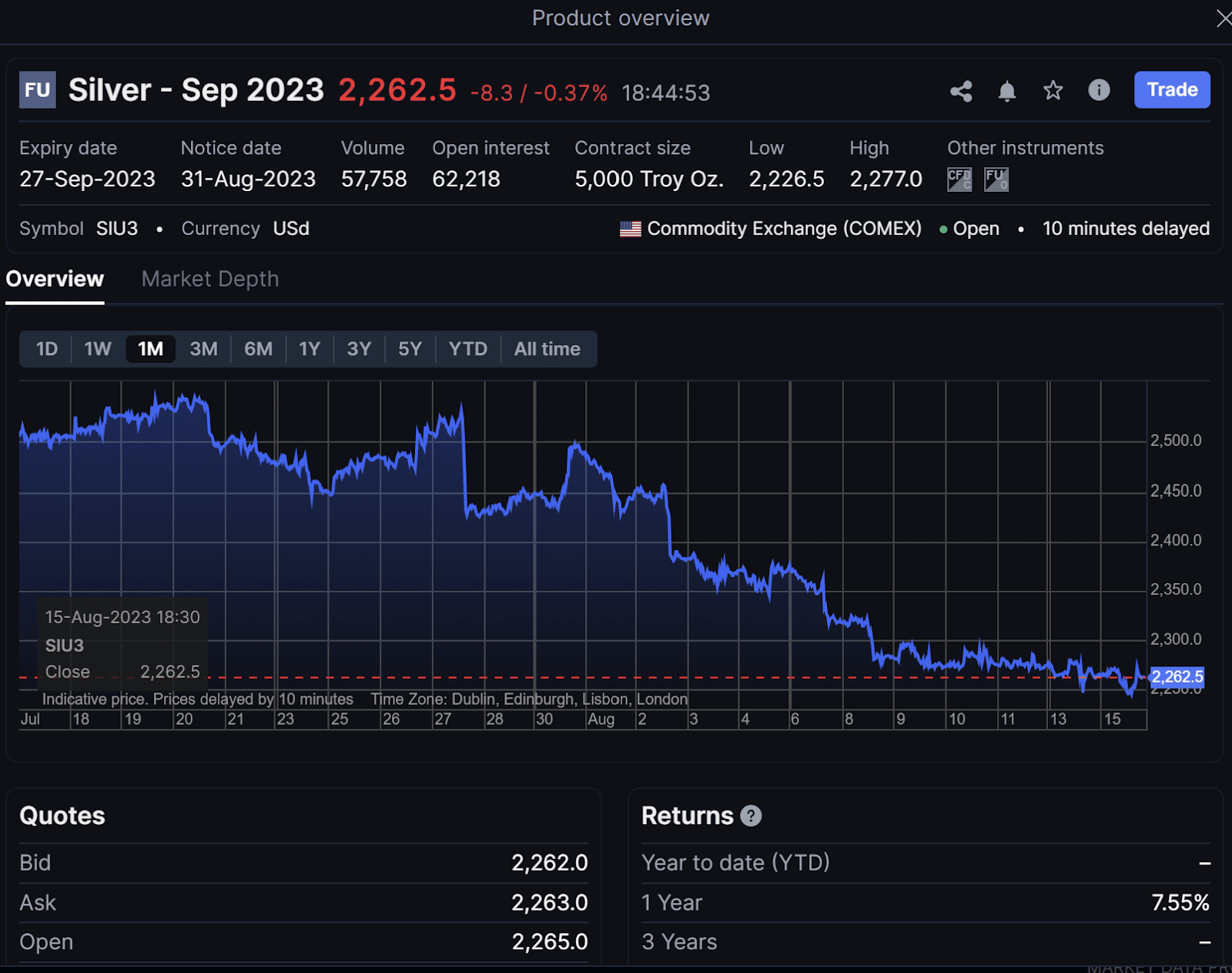
The platforms also show a lot of information to support your decisions. The screenshot below shows pricing and other data on silver futures contracts.
Saxo also pays interest on uninvested cash in several currencies, including pounds, euros and dollars. Rates depend on the currency, your account tier and the balance.
In the UK, interest is only paid on balances of 5,000 or more in GBP, USD or EUR. Balances up to 4,999 earn nothing. GBP rates follow SONIA (the Bank of England overnight benchmark) minus a markdown, and higher tiers get better rates.
The breadth of products on Saxo’s platforms remains one of its key strengths. Few providers match it.
Fees
Saxo’s fees depend on where you live and on your account tier. The tier is set by how much you deposit (or, for some tiers, how much you trade).
Saxo offers three main account tiers: Classic, Platinum and VIP. In April 2026 it added a top tier called Saxo Elite for clients with more than 5 million in assets. In the Netherlands, the tiers are called Bronze, Silver and Gold.
| Region | Classic | Platinum | VIP |
| UK | £0 | £200,000 | £1,000,000 |
| International (Saxo Bank A/S) | €0 | €200,000 | €1,000,000 |
| Singapore | SGD 0 | SGD 300,000 | SGD 1,500,000 |
| UAE | $5,000 | $250,000 | $1,250,000 |
Deposit needed for each tier. Source: Saxo account types, September 2026.
Exchange-traded products, like stocks or listed options, carry a commission per trade or per contract.
For stocks, Saxo charges 0.08% on the Classic account in the UK, with no minimum. For example, buying $5,000 of Apple costs $4. Through Saxo Bank A/S (most EU and international clients), US stocks start at $1, German stocks at €3, and a €4,550 Porsche order costs €3.60. Rates fall on the Platinum and VIP tiers.

Over-the-counter derivatives, like forex and CFDs, are priced mainly through the spread, the difference between the buy and sell price. Some products also carry a commission.
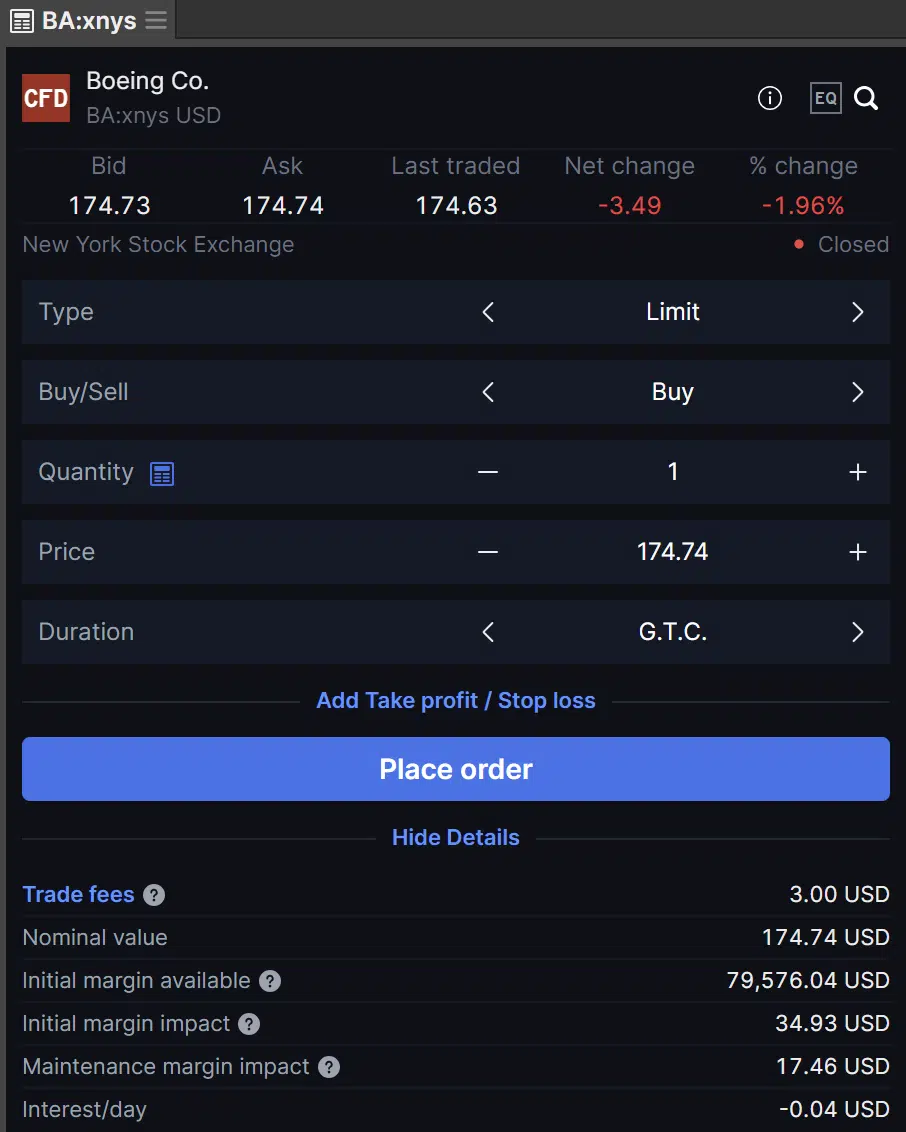
SaxoTrader shows the full cost of a trade before you place it, as in the example below for a CFD on an ETF.
The currency conversion fee is charged whenever you trade in a currency different from your account currency.
| Region | Classic | Platinum | VIP |
| UK | 0.60% | 0.40% | 0.20% |
| International (Saxo Bank A/S) | 0.25% | 0.25% | 0.25% |
| Singapore | 0.25% | 0.25% | 0.25% |
| UAE | 0.50% | 0.50% | 0.50% |
Currency conversion fee by tier. Source: Saxo commissions schedule and Saxo UK schedule, September 2026.
Custody fees, charged on the value of stocks, ETFs and bonds you hold, were removed in most of Saxo’s core markets during its 2024 and 2025 price overhaul. They still apply in a few regions.
| Residence | Custody fee (Classic) |
| Denmark, France, Belgium, Italy, Switzerland, Japan, Poland | 0% |
| Netherlands | 0.01% per month (max €40), refunded as trading credit |
| UK | 0.12% (0.08% VIP) |
| Singapore | 0% with securities lending, otherwise 0.12% |
| Other CEE countries | 0% with securities lending, otherwise 0.15% |
| UAE | 0.15% (0.05% VIP) |
Annual custody fee on stocks, ETFs and bonds. Source: Saxo commissions schedule, September 2026.
Other fees to keep in mind:
- Financing costs: also called overnight or swap fees, this is the interest you pay on borrowed money when you hold leveraged positions like CFDs overnight.
- Transfer out (UK): €50 per line, up to €160.
- Manual orders (UK): €50 per order placed by phone.
There are no inactivity or withdrawal fees.
This is not a full list of Saxo’s fees. Because Saxo serves many regions through different entities, always check the rate card for your country before opening an account.
Regulation
Saxo is regulated in several developed markets with strict standards.
Because Saxo is a global company, many investors live in countries where it has no local subsidiary, only a branch or a representative office. A branch is part of the parent bank, so it is supervised mainly by the home regulator. A representative office can promote Saxo’s services, but the account is provided by a regulated entity elsewhere.
In practice, if your country has no Saxo subsidiary, your account is opened with Saxo Bank A/S in Denmark, supervised by the Danish FSA (Finanstilsynet). That includes clients in the Netherlands, France and Belgium, which are served through branches of Saxo Bank A/S. The table below shows each office.
Saxo offices
| Country | Type | Regulator |
| 🇩🇰 Denmark | Headquarters (Saxo Bank A/S) | Danish FSA |
| 🇬🇧 UK | Subsidiary | FCA |
| 🇸🇬 Singapore | Subsidiary | MAS |
| 🇨🇭 Switzerland | Swiss bank | FINMA |
| 🇯🇵 Japan | Subsidiary | JFSA |
| 🇮🇹 Italy | Subsidiary (Saxo SIM) | Consob and Banca d’Italia |
| 🇳🇱 Netherlands | Branch | Danish FSA |
| 🇫🇷 France | Branch | Danish FSA |
| 🇧🇪 Belgium | Branch | Danish FSA |
| 🇨🇿 Czech Republic | Branch | Danish FSA |
| 🇦🇪 UAE | Representative office | Danish FSA |
| 🇧🇷 Brazil | Representative office | Danish FSA |
Main supervisor of each Saxo office. Source: Saxo country websites, September 2026.
Saxo has also left two markets. It closed its Hong Kong business in 2024, and in 2025 it sold a majority of Saxo Australia to DMA, which now operates as Totality Wealth.
Every Saxo entity must keep client assets segregated from its own. That means your investments are not mixed with the firm’s money. On top of that, investor compensation schemes cover part of your assets if a firm fails and cannot return them.
| Entity | Coverage | Scheme |
| UK | £85,000 (investments), £120,000 (cash) | FSCS |
| Denmark and branches | €20,000 (securities), €100,000 (cash) | Danish Guarantee Fund |
| Switzerland | CHF 100,000 (cash) | esisuisse |
| Italy | €20,000 | Fondo Nazionale di Garanzia |
Investor and deposit protection per client. Source: Saxo client fund protection and Saxo UK client money protection, September 2026.
Saxo Bank A/S is one of the seven banks on the Danish FSA’s 2026 list of systemically important institutions, which means stricter capital and supervision requirements. It also holds an A- rating from S&P Global Ratings, with a positive outlook since August 2026.
Saxo also stands out for transparency. It publishes its annual and half-year reports on its Investor Relations page, shown below. For 2025 it reported a net profit of EUR 72 million and 1.52 million clients.

These reports let potential clients check the firm’s financial strength and how it runs its business.
Accepted countries
Saxo serves clients from dozens of countries, and the list changes over time. According to Saxo’s help centre, it services clients in:
Austria, Belgium, Croatia, Czech Republic, Denmark, Estonia, Faroe Islands, Finland, France, Germany, Greece, Greenland, Hungary, Iceland, Ireland, Israel, Italy, Japan, Latvia, Lithuania, Luxembourg, Malaysia, Malta, Monaco, Netherlands, Norway, Poland, Portugal, Qatar, Romania, Saudi Arabia, Singapore, Slovakia, Slovenia, Spain, Sweden, Switzerland, Thailand, United Arab Emirates and the United Kingdom.
Saxo warns that the countries where it services clients may differ from those where it opens new accounts. US persons, including US citizens living abroad, cannot open an account.
User reviews
At the end of September 2026, the SaxoTrader app had a rating of 4.5 on the UK Apple App Store, from about 3,300 ratings, and 4.3 on Google Play, from over 9,000 reviews. The SaxoInvestor app had 4.7 on the App Store and 4.3 on Google Play.

Account opening
Opening an account with Saxo is simple and does not take long. To start, click ‘Open account’ on the broker’s homepage.

You then fill in some basic details:
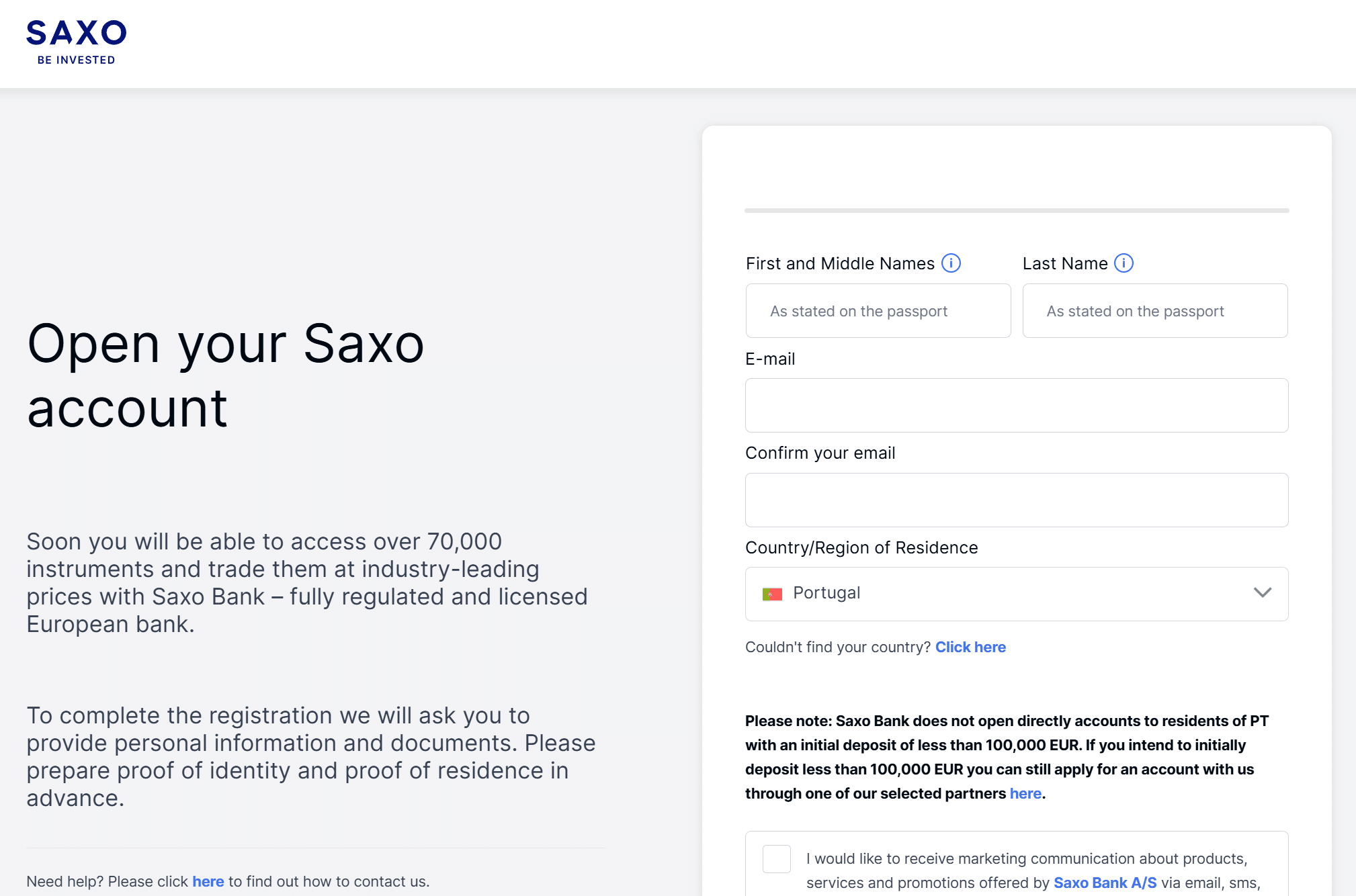
You will need to provide proof of identity and some tax information, so have your passport or driving licence ready to make the process smoother.
Finally, you add your bank details so you can make your first deposit.
Deposit methods depend on your country. In the EU you can use a bank transfer or SEPA Instant (up to €100,000), and card payments are available in some countries. In the UK you can use Instant Funding in GBP or a bank transfer. Debit cards are accepted only after your first deposit by bank transfer, and not for ISAs.
Alternatives
Saxo is a strong choice for experienced traders and for investors who want a multi-product broker with a solid reputation.
There are other good options outside the US, though. Our first choice would be Interactive Brokers, a global broker that also offers a very wide range of products.
It suits investors who want international stocks, ETFs, bonds, futures, options and even penny stocks, with a long track record and low trading costs. See our Interactive Brokers vs Saxo comparison for a side-by-side look.

Frequently asked questions
Who owns Saxo?
Saxo is wholly owned by the Swiss J. Safra Sarasin group. It bought a majority stake of about 71% in March 2026 and agreed to buy founder Kim Fournais’ remaining stake in July 2026.
Is Saxo regulated?
Yes. Saxo Bank A/S is a Danish bank supervised by the Danish FSA, and its subsidiaries are regulated by the FCA in the UK, MAS in Singapore, FINMA in Switzerland, Consob in Italy and the JFSA in Japan.
Does Saxo accept US clients?
No. Saxo does not open accounts for US persons, including US citizens living abroad.
Does Saxo charge custody fees?
It depends on where you live. There is no custody fee in markets like Denmark, France, Belgium, Italy and Switzerland, while UK clients on the Classic tier pay 0.12% a year.
Does Saxo offer MetaTrader?
No. Saxo offers its own SaxoInvestor and SaxoTrader platforms, plus TradingView and API connections.
Bottom line
Saxo is a well-respected broker and a strong option for anyone who wants to invest long-term or trade more speculative products from a single account.
Its main strengths are the huge range of products, good customer support and platforms built for different types of investors.
Saxo is regulated in tier-1 jurisdictions, is designated a systemically important bank in Denmark and publishes clear financial reports. Since 2026 it has also been backed by J. Safra Sarasin, a large Swiss private banking group.
Its fees are no longer as high as they once were, but they still vary a lot by country, so check the rate card for yours. Custody and currency conversion fees in the UK are notably higher than in most EU markets.
